

An era of heat waves comes to an end in Sydney for this year. Autumn has set and temperature has started to drip. We wake up to chill mornings only to go back to bed longing for the end of Daylight Savings Time (DST). DST ends on the 6th of April this year. Yay! Time to move our clocks backward.The concept of DST was introduced by George Hudson in 1895 merely for convenience.
During summer the daylight lasts longer than in winters. In order to make maximum use of the sunlight, the clock is advanced 1 hour during spring and then set back by an hour during autumn. So we move an hour forward than the actual time during spring and get back to the original time during autumn.
DST doesn’t happen at the same time for all the countries because they all have different seasons at different times. DST starts on First Sunday in October and ends on First Sunday in April in Australia. Whereas it starts on Second Sunday in March and ends on first Sunday in November in America.
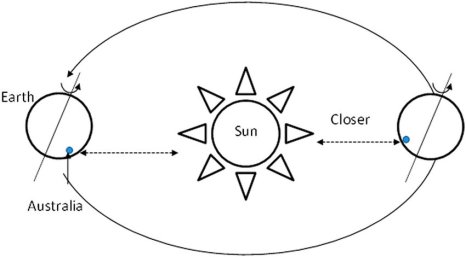
Our Earth spins around the sun with an axial tilt of 23.4° (known as obliquity) with respect to its orbit. Due to this tilt there is a large variation in the amount of sunlight falling on our planet.


Equator is an imaginary line on our globe, running East-West and dividing earth equally into northern and southern hemisphere.Countries close to the equator are exposed to maximum sunlight throughout the year.
Lack of significant changes in sunlight in the equatorial region is responsible for lack of seasonal changes in these places. They have uniform tropical climate throughout the year. Similarly DST is insignificant for countries closer to the poles as their day and night changes extremely with seasons.

On the contrary, at a given instant, different parts of non-equatorial regions receives different amount of sunlight (due to the axial tilt). The uneven distribution of sunlight results in difference in seasons among the countries. So,when Aussies face an extreme summer, the Americans undergo the pricking winter.
 The Know-how Science club